









Adeno-associated Virus (AAV) belongs to the family Parvoviridae. It is a non-enveloped virus with an icosahedral structure, approximately 20 nm in diameter. AAV is currently recognized as one of the structurally simplest linear single-stranded DNA viruses, incapable of autonomous replication. It possesses the ability to infect both dividing and non-dividing cells. Through directed mutagenesis of the AAV capsid protein via artificial evolution, AAV vectors with high transduction efficiency and varied infection characteristics can be selected. This significantly expands the therapeutic potential of AAV in various applications.
Fubio offers an extensive range of AAV products, with over 20,000 off-the-shelf options available from our stock library. Our products cover various applications, including AAV overexpression, interference, and knockout. We also support custom product solutions to fully meet our clients' specific needs.
Product Advantages
Short experimental cycle: Product customization can be as fast as 7 working days
High product titer: The product titer can reach over 1E+13vg/ml
Strict quality control: 10 process quality controls and 6 quality inspections
No mycoplasma contamination: Multiple serotypes are available for selection
Specific promoters: Over 50 types of specific promoters fully meet the research and experimental requirements.
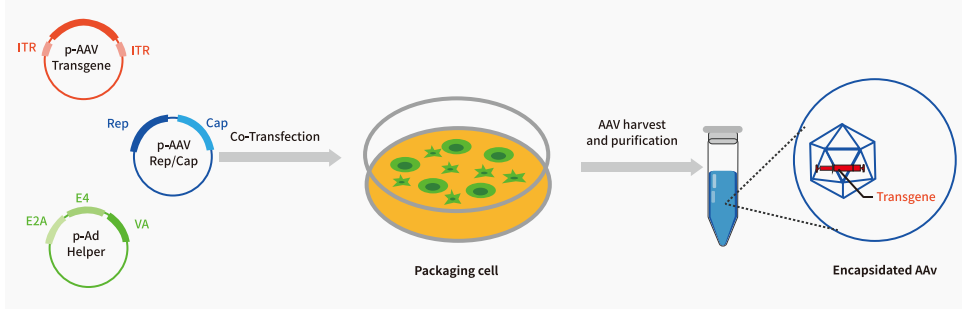
Schematic diagram of AAV virus packaging
Recombinant adeno-associated virus is a chimeric viral vector produced by binding the AAV genome with the capsid protein genomes of different serotypes. By engineering modifying the capsid protein of AAV, AAV vectors with high transduction efficiency and different infection characteristics can be screened out, which greatly increases the application potential of AAV.
Service content
Single-stranded AAV (ssAAV) and self-complementary AAV (scAAV)
Various serotypes: 1, 2, 3, 4, 5, 6, 6.2, 7, 8, 9, rh10, DJ, DJ/8, PHP.eB, PHP.S, AAV2-retro, AAV2-QuadYF, AAV2.7m8, etc.
AAV empty capsids or virus-like particles (VLPs)
-
- Item No.
- Name
- Specification
- Function
- Download
-
- AAV2
- FAAV2-319
- 50μl/支
- Gene overexpression
- No Instructions
-
- FAAV2-295
- AAV2-CMV-EGFP
- 50μl/支
- Gene overexpression
- No Instructions
-
- FAAV5-319
- AAV5-Luciferase
- 50μl/支
- Gene overexpression
- No Instructions
-
- FAAV5-295
- AAV5-CMV-EGFP
- 50μl/支
- Gene overexpression
- No Instructions
-
- FAAV8-319
- AAV8-Luciferase
- 50μl/支
- Gene overexpression
- No Instructions
-
- FAAV8-295
- AAV8-CMV-EGFP
- 50μl/支
- Gene overexpression
- No Instructions
-
- FAAV8-350
- AAV8-SYN-EGFP
- 50μl/支
- Gene overexpression
- No Instructions
-
- FAAV8-069
- AAV8-GFAP-EGFP
- 50μl/支
- Gene overexpression
- No Instructions
-
- FAAV8-377
- AAV8-TBG-EGFP
- 50μl/支
- Gene overexpression
- No Instructions
-
- FAAV8-7482
- AAV8-TBG-Cre
- 50μl/支
- Gene overexpression
- No Instructions
-
- FAAV8-5643
- AAV8-1.3xHBV(D,ayw)
- 50μl/支
- Gene overexpression
- No Instructions
-
- FAAV8- 7409
- AAV8-HCRApoE/hAAT-mPCSK9-D377Y
- 50μl/支
- Gene overexpression
- No Instructions
-
- FAAV8- 7410
- AAV8-HCRApoE/hAAT-hPCSK9-D374Y
- 50μl/支
- Gene overexpression
- No Instructions
-
- FAAV9-319
- AAV9-Luciferase
- 50μl/支
- Gene overexpression
- No Instructions
-
- FAAV9-295
- AAV9-CMV-EGFP
- 50μl/支
- Gene overexpression
- No Instructions
-
- FAAV9-350
- AAV9-SYN-EGFP
- 50μl/支
- Gene overexpression
- No Instructions
-
- FAAV9-069
- AAV9-GFAP-EGFP
- 50μl/支
- Gene overexpression
- No Instructions
-
- FAAV9-377
- AAV9-TBG-EGFP
- 50μl/支
- Gene overexpression
- No Instructions
-
- FAAV9-7482
- AAV9-TBG-Cre
- 50μl/支
- Gene overexpression
- No Instructions
-
- FAAV9- 7409
- AAV9-HCRApoE/hAAT-mPCSK9-D377Y
- 50μl/支
- Gene overexpression
- No Instructions
-
- FAAV9- 7410
- AAV9-HCRApoE/hAAT-hPCSK9-D374Y
- 50μl/支
- Gene overexpression
- No Instructions
 Official Account
 Video Account